Outer Banks Wild Horses & Corolla Tourism
Discover the Outer Banks Wild Horses in Corolla and learn how these iconic mustangs shape tourism, history, and conservation in OBX.
Published
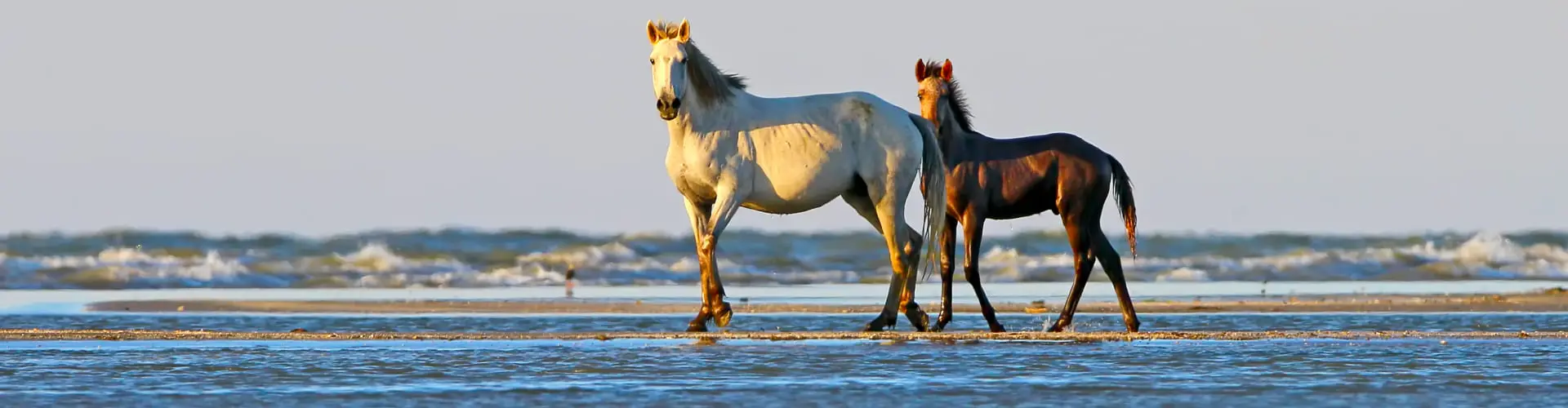
In the far northern reaches of the Outer Banks, along the sandy stretch between Corolla and the Virginia state line, something unmistakably unique roams free - wild Colonial Spanish Mustangs. These rugged and iconic horses, often simply called the Corolla wild horses, are more than a scenic attraction. They are living history, a conservation priority, and an unexpected driver of tourism that shapes the culture and economy of the northern Outer Banks.
For many visitors, spotting these mustangs grazing on windswept dunes or wandering along the 4×4 beach is the highlight of an Outer Banks vacation. But their presence also raises questions about heritage, habitat protection, economic benefit, and responsible wildlife tourism, making the Corolla wild horses one of the Outer Banks’ most compelling stories.
Why the Outer Banks Wild Horses Are a Must-See OBX Attraction
A Legacy on the Shoreline: History and Mystique
The exact origin of the Corolla wild horses remains partly shrouded in legend, but evidence shows they have been here for centuries. DNA studies confirm that the horses are descendants of Spanish Mustangs — an ancient breed brought to the Americas by explorers in the 16th century. Some historians believe they are descendants of livestock left behind after shipwrecks along the treacherous “Graveyard of the Atlantic.”
Thanks to coordinated conservation efforts between local authorities, federal partners, and community volunteers, the herd was moved north of the paved road in the mid-1990s to an area now largely accessible only by four-wheel-drive vehicles. Over 7,500 acres of shoreline, dunes, estuaries, and maritime forests now serve as the primary range for the wild mustangs.
For centuries, they survived hurricanes, shipwreck lore, and isolation on barrier islands long before paved roads arrived. In fact, development posed one of their biggest modern threats. When NC Highway 12 extended into Corolla in the 1980s, vehicle strikes began killing horses. In 1989, residents formed the Corolla Wild Horse Fund to protect the herd. By the mid-1990s, the horses were relocated north of the paved road into a 7,500-acre protected habitat of dunes, beaches, and maritime forest.
These horses are not a zoo exhibit. They live in family groups called harems - with one dominant stallion, several mares, and their foals - and roam much as their ancestors did.
The Colonial Spanish Mustang is considered one of the rarest horse breeds in the world and is listed as critically endangered by breed conservation organizations. In 2010, this designation was honored by the state when the wild horses were named the official state horse of North Carolina.
Tourism Follows the Horses
Today, seeing wild horses is one of the top reasons visitors head to northern Corolla. During peak summer, tens of thousands of visitors pass through the area weekly, and horse sightings are often the main attraction.
That demand has shaped an entire micro-economy -
- 4×4 Tour Companies Guided wild horse tours operate daily, taking visitors beyond paved roads into the Carova area. These tours, besides being scenic drives, provide structured wildlife education, safe viewing distances, and historical context. They also reduce random vehicle traffic that could disturb the horses.
- Vacation Rentals Properties in the 4×4 zone frequently advertise “horse sightings” as a premium feature. Some homes market decks where horses have been seen grazing nearby. Proximity to the herd directly influences rental value.
- Conservation Funding Tourism fuels donations. The Corolla Wild Horse Fund operates largely through public support, merchandise sales, and visitor engagement. Without tourism awareness, funding would shrink and so would protection efforts. The horses generate economic value without ever being owned, staged, or domesticated. That balance is rare.
- Museums and Education Centers The Corolla Wild Horse Fund’s museum and visitor center offer exhibits on the herd’s history, genetics, and conservation needs, turning tourism into learning. There are local gift shops, equine art galleries, and special events like “Mustang Mornings” that connect visitors with the horses and contribute to local economies.
All of this allows the horses to serve as both a conservation success story and an economic driver while also bringing unique challenges.
The Conservation Tightrope
But the wild horse economy only works if the horses stay wild. Visitors are legally required to remain at least 50 feet away from the horses. Feeding them, even apples or carrots, can cause severe digestive problems and death because their systems are adapted to native vegetation. Vehicle interaction remains one of the greatest threats. Even in recent years, horses have been injured or killed in beach traffic incidents. The herd is carefully managed to maintain genetic diversity and sustainable population numbers. This is not a petting zoo. It’s a living conservation effort playing out in real time.
The wild horses draw visitors who enrich the local economy, and at the same time, those visitors are entrusted with protecting a rare genetic lineage and cultural treasure. When families plan their next Outer Banks trip, a wild horse sighting can be both a thrilling highlight and a gentle reminder that some of the most memorable experiences are the ones that come with responsibility. Because in Corolla, you’re not just observing wildlife, you’re helping sustain it.
Myths and Misconceptions
There are several popular misconceptions about the Corolla wild horses:
Myth: You can pet or ride the horses. Reality: The horses are strictly wild; approaching them can be unsafe and illegal.
Myth: The herd is a wildlife refuge. Reality: The horses are protected by local ordinances and conservation efforts but do not live in a formal refuge. Their habitat spans a mix of public and private land.
Myth: They were introduced for tourism. Reality: Their presence predates tourism by centuries, and tourism evolved after generations of coexistence.
FAQ Suggestions
1) Where can you see the Outer Banks Wild Horses?
The Corolla Wild Horses can be seen in the northern Outer Banks near Carova, primarily in the 4x4 beach areas north of Corolla.
2) Can visitors touch or feed the Corolla Wild Horses?
No, visitors must stay at least 50 feet away and should never feed or touch the horses for their safety and protection.
3) What is the best way to see the Corolla Wild Horses?
Guided 4x4 wild horse tours are one of the safest and most popular ways to see the horses while learning about their history.
4) Why are the Corolla Wild Horses important?
The horses are part of Outer Banks history, a rare Colonial Spanish Mustang breed, and a major attraction supporting local tourism and conservation.
5) How did the wild horses get to the Outer Banks?
The Outer Banks Wild Horses are believed to be descendants of Colonial Spanish Mustangs brought to America by Spanish explorers in the 16th century, possibly surviving shipwrecks along the coast.